Multi-Tenant WordPress Management: Why Data Isolation Between Clients Actually Matters
Any platform serving more than one agency from the same underlying system eventually has to answer an uncomfortable question honestly: what actually stops one account from seeing another’s data? “The interface just doesn’t show it to you” is not a real answer — it’s a UI convenience, not a security boundary, and UI conveniences can be worked around in ways a genuine architectural boundary can’t.
Table of contents
- Interface hiding versus real isolation
- How WP Warden actually enforces this
- Why this should matter to you specifically
- FAQ
- What to actually ask a vendor about this
Interface hiding versus real isolation
Plenty of multi-tenant software gets this wrong in a specific, subtle way: the application layer filters what you see, but the database itself has no concept of tenant boundaries at all. That’s a single application bug away from one agency’s client list showing up in another agency’s dashboard — not a hypothetical, but a real and recurring category of bug across the software industry generally. The fix isn’t a smarter interface; it’s making the isolation something the database enforces on every single query, not something the application merely promises to respect.
How WP Warden actually enforces this
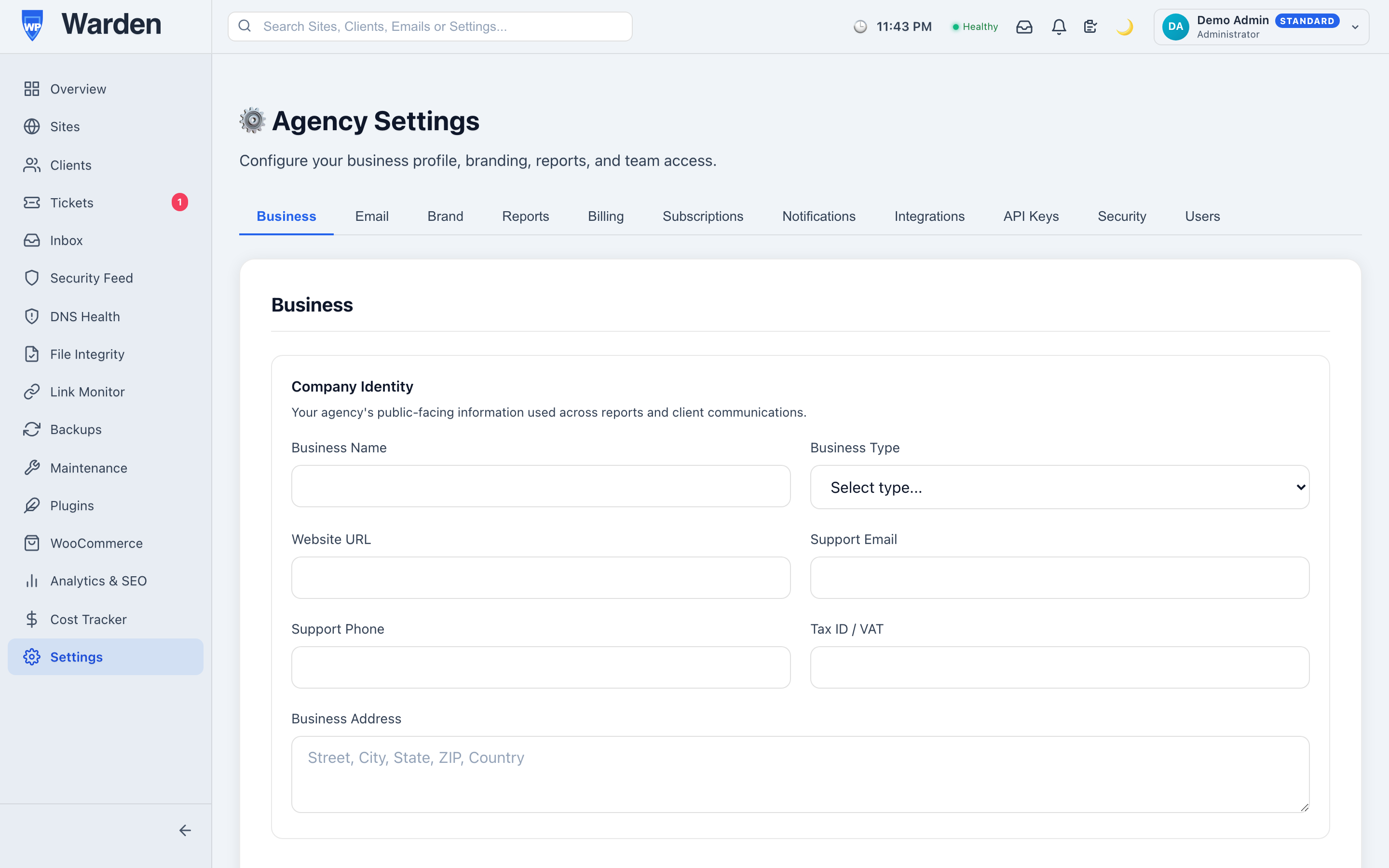
WP Warden’s multi-tenant architecture isolates every agency account as its own separate tenant — its sites, clients, and settings are never visible to, or reachable from, any other agency account on the platform. Every database query on every protected route is filtered by tenant ID, so the isolation exists at the infrastructure layer itself, not as a display-layer convenience that a bug elsewhere could accidentally bypass.
Why this should matter to you specifically
If you manage client data with real names, real contact details, and real site credentials attached, the platform underneath you is only as trustworthy as its weakest architectural assumption. Every other feature in WP Warden — clients, sites, reports, portals — is built on top of this specific guarantee actually holding. It’s worth understanding not because you’ll ever interact with it directly, but because everything else you do rely on depends on it being true.
What to actually ask a vendor about this
Most vendors will say “yes, your data is isolated” if asked directly, because it’s rarely a lie exactly — it’s just often true only at the interface layer, not the database layer underneath. A more useful question is more specific: is tenant isolation enforced in the database query itself, or only in what the application chooses to display. The first answer describes a real architectural guarantee. The second describes a convention that depends on every single line of application code getting it right, forever, with no second layer of defense if one line doesn’t.
FAQ
Is isolation just enforced by the interface?
No — every database query on every protected route filters by tenant ID at the query level itself, not just what the interface happens to display.
Does isolation weaken as the platform grows?
No — the same guarantee applies per tenant regardless of how many other agency accounts exist on the platform at the same time.
Start a free 14-day trial — no credit card required.